Compressor Technology & Engineering

Explore the engineering principles, material science, and performance optimization methodologies behind every CopelandTech compressor platform.

Scroll Geometry Optimization

Our scroll compressor design uses a proprietary involute profile optimized through computational fluid dynamics (CFD) to minimize leakage paths between scroll flanks. The result is a measurably higher volumetric efficiency — typically 3-5% above conventional scroll profiles at the same displacement.

Each scroll set undergoes coordinate measuring machine (CMM) inspection to maintain flank clearances within 8 microns, ensuring consistent performance across production runs.

Key metric: COP of 4.8 at AHRI Standard 540 conditions (45°F evaporating, 130°F condensing) with R-410A refrigerant. AHRI-certified.
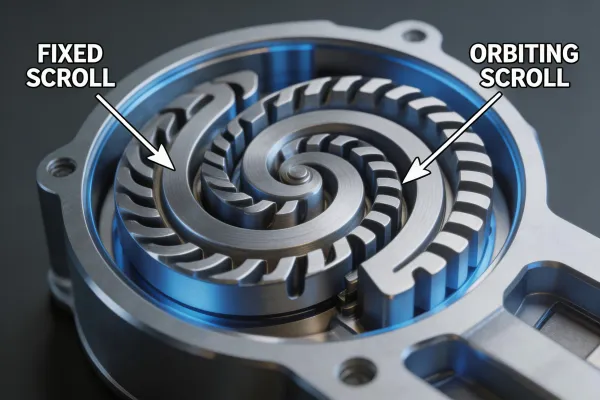
Scroll compressor cutaway showing involute geometry

Inverter-Driven Variable Speed Control

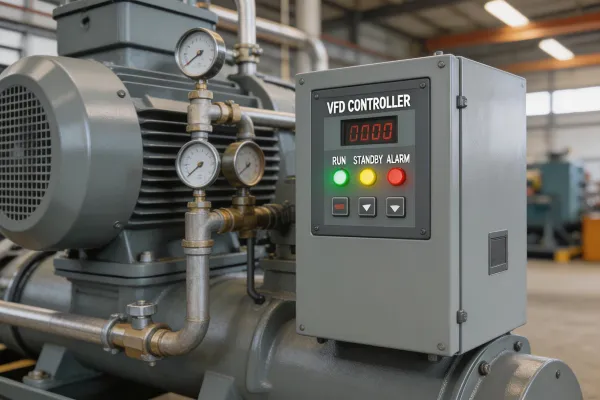
Our variable frequency drive (VFD) integration operates from 15 Hz to 120 Hz, allowing the compressor to modulate capacity from 20% to 100% continuously. This eliminates the inefficiency of on-off cycling and provides precise superheat control under partial load conditions.

At 50% load — where most commercial systems operate 60-70% of their annual hours — our inverter-driven compressors achieve an IPLV improvement of 35-42% compared to fixed-speed equivalents.

Parameter Fixed Speed CopelandTech VFD
Capacity Range 100% only 20%-100%
Part-Load COP (50%) 3.2 5.1
IPLV Improvement Baseline +35-42%
Soft Start No (inrush 6x LRA) Yes (<2x LRA)
Variable speed drive controller for compressor modulation

Low-GWP Refrigerant Platform

The shift from high-GWP HFCs to natural and synthetic low-GWP alternatives is the most significant material change facing the refrigeration industry. CopelandTech has validated every current compressor platform for at least one low-GWP option:

  • R-290 (Propane): GWP of 3. Scroll series validated and in production. Requires ATEX-rated motor and charge-limiting design.
  • R-744 (CO2): GWP of 1. Transcritical reciprocating series for medium/low temperature commercial refrigeration.
  • R-1234ze(E): GWP of 7. Drop-in compatible with existing R-134a scroll platforms with minor valve adjustments.
  • R-454B: GWP of 466. Scroll and semi-hermetic series for HVAC transition from R-410A.
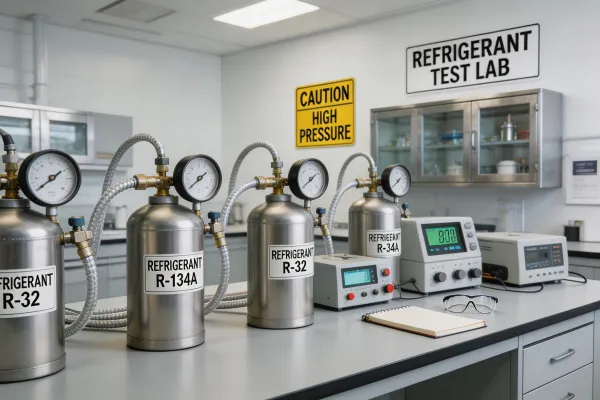
Refrigerant compatibility testing laboratory

Integrated Diagnostics & Connectivity

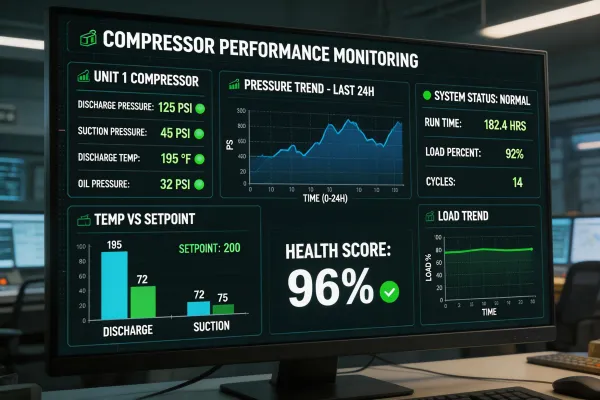
Every CopelandTech compressor above 10 HP ships with onboard sensors measuring vibration, discharge temperature, suction/discharge pressure, oil pressure, and motor winding temperature. Data is available via Modbus RTU or BACnet MS/TP for integration with building management systems (BMS).

Our optional cloud gateway enables remote monitoring with configurable alarm thresholds, trend analysis, and predictive maintenance alerts based on vibration spectrum analysis — detecting bearing wear patterns 2-4 weeks before failure.

Compressor diagnostics monitoring interface

Compressor Selection: Engineering Trade-offs

Compressor selection involves trade-offs that depend on load profile, refrigerant strategy, facility constraints, and total cost of ownership. Below we present two of the most common engineering decisions our customers face, with the factual arguments on each side.

Inverter (Variable Speed) vs. Fixed Speed Compressors

The choice between variable-speed and fixed-speed compression is driven by application load variability, capital budget, and maintenance infrastructure.

Case for Variable Speed (Inverter)

  • 30-50% energy savings at part load conditions, validated by AHRI IPLV testing
  • Precise superheat control through continuous capacity modulation (20%-100%)
  • Soft-start capability reduces inrush current to <2x locked rotor amps, extending motor and contactor life
  • Essential for variable-load applications like data centers where cooling demand fluctuates hourly

Case for Fixed Speed

  • 15-25% lower capital cost per unit of cooling capacity
  • Simpler controls — no VFD programming, no harmonic filtering requirements
  • Easier field maintenance with standard motor components and widely available spares
  • Proven reliability in constant-load applications such as industrial process cooling and ice production where the compressor runs at 95%+ load continuously

Selection guidance: For applications with annual load variation >40%, inverter-driven compressors typically achieve payback within 2-3 years through energy savings. For constant-load industrial processes, fixed-speed units deliver lower lifecycle cost.

HFC Phase-Down: Natural Refrigerants vs. Synthetic Low-GWP HFOs

The Kigali Amendment and EU F-Gas Regulation are driving the global transition away from high-GWP HFCs. Two competing paths have emerged, each with legitimate engineering and economic arguments.

Natural Refrigerants (R-290, R-744, R-717)

  • GWP of 3 or less — fully future-proof against any foreseeable regulation tightening
  • No patent dependencies — multiple compressor and component suppliers available
  • CO2 transcritical systems increasingly viable even in warm climates (>35°C ambient) with parallel compression and ejector technology
  • Lower long-term refrigerant cost due to commodity pricing

Limitations: R-290 is flammable (A3 classification), requiring ATEX-rated motors and strict charge limits per EN 378. R-717 (ammonia) is toxic, restricting use in occupied spaces. R-744 systems operate at high pressure (up to 120 bar), requiring specialized components and higher design pressure ratings.

Synthetic Low-GWP HFOs (R-1234yf, R-1234ze, R-454B)

  • Drop-in or near-drop-in compatibility with existing HFC infrastructure, reducing retrofit cost by 40-60%
  • No flammability or toxicity concerns at A2L classification level (mildly flammable, lower risk than A3 naturals)
  • Faster adoption path — existing technician workforce requires minimal retraining
  • GWP values of 1-466, meeting current regulatory thresholds

Limitations: HFO patents are held by a small number of chemical manufacturers, creating supply concentration risk. R-454B (GWP 466) may face further restrictions as F-Gas quotas tighten post-2030. Long-term atmospheric breakdown products (TFA — trifluoroacetic acid) are under environmental review by the EU.

CopelandTech position: We validate compressor platforms for both pathways because the optimal choice depends on application type, geographic regulation, and existing infrastructure. Our engineering team provides refrigerant transition roadmaps tailored to each customer's regulatory timeline and technical constraints.

Performance Boundaries & Operating Limitations

Every compressor has defined operating limits. Exceeding these boundaries degrades performance, accelerates wear, and voids warranty coverage. We publish these limits because transparent engineering data prevents field failures.

Ambient Temperature Limits

Air-cooled condensing applications: maximum ambient 52°C for scroll series, 55°C for semi-hermetic reciprocating series. Above these temperatures, compressor discharge temperature exceeds safe limits for lubricant stability, even with enhanced oil cooling. Water-cooled applications are not subject to this constraint but require condenser water below 35°C.

Low-Temperature Cascade Boundaries

Single-stage compressors are rated to -40°C evaporating temperature. For applications requiring temperatures below -40°C (such as pharmaceutical freeze-drying or chemical process cooling), a two-stage cascade system with R-744 or R-170 on the low stage is required. Single-stage operation below -40°C results in compression ratios exceeding 12:1, causing excessive discharge temperatures and rapid valve wear.

Sound Level Considerations

Reciprocating compressors in the 40-120 HP range produce 72-85 dB(A) at 1 meter, which exceeds OSHA permissible exposure limits for continuous operation. Sound enclosures or remote mechanical room installation are required for occupied-space proximity. Scroll compressors operate 8-15 dB(A) lower at equivalent capacity but are limited to 40 HP maximum.

VFD Harmonic Distortion

Inverter-driven compressors generate harmonic distortion (THD) on the electrical supply. Without input line reactors or active harmonic filters, THD can reach 30-40% on the supply bus, potentially affecting sensitive equipment sharing the same electrical panel. IEEE 519 compliance requires THD below 5% at the point of common coupling — an additional cost factor of 8-12% on the VFD package.

Want to Discuss a Technical Application?

Our application engineering team can provide selection guidance, performance simulations, and refrigerant transition consulting for your specific project requirements.

Speak With an Engineer